October 10, 2026 · By Chris Floersch
Number 19: Walt Sikes and His 1955 Austin-Healey 100
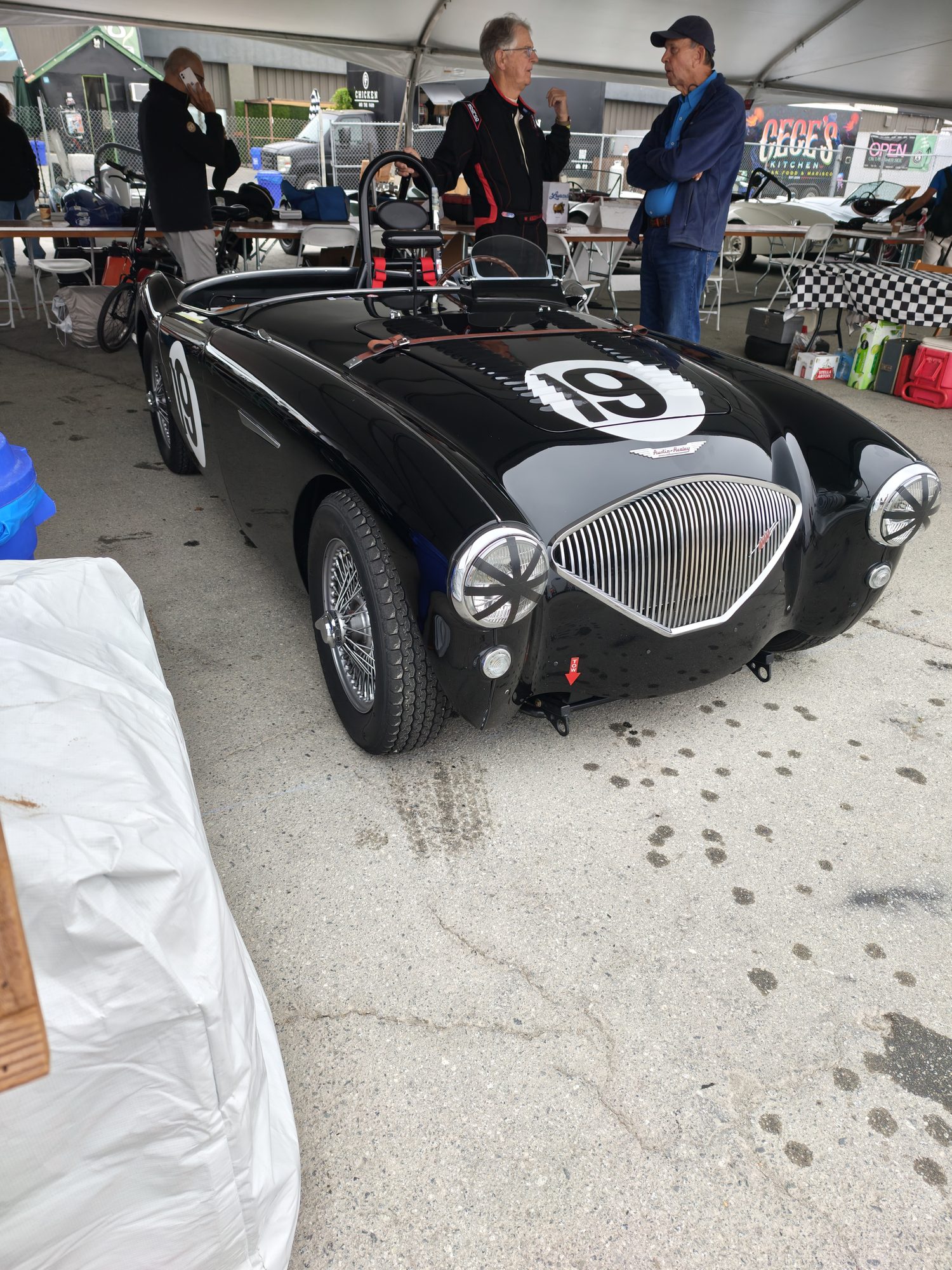
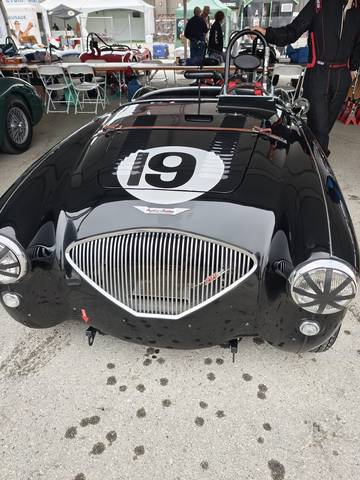
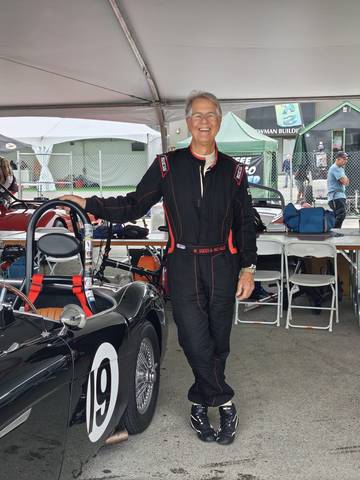
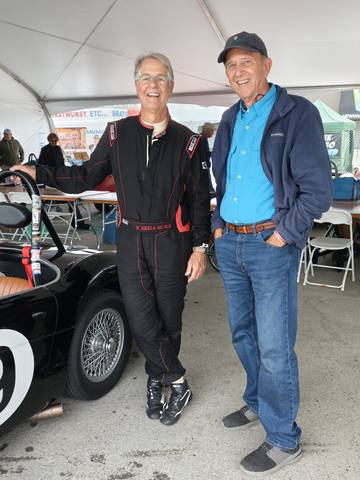
Under the paddock tents at the Rolex Monterey Motorsports Reunion this August, one car kept drawing a crowd: a gloss-black Austin-Healey with a big white 19 painted across its hood. Next to it, one hand resting on the roll bar, stood the man whose name is stitched on the belt of his race suit: W. Sikes. That's Walt Sikes, the car's owner and driver. He spent most of the afternoon talking cars with anyone who stopped by and laughing at whatever they said back.
Walt's Healey was racing with the Pebble Beach Road Racers, a group made up of the kinds of cars that raced on the roads of Pebble Beach in the early 1950s. This year the group filled a record grid of 40 cars: Jaguars, Allards, MGs, Aston Martins, Porsches, Coopers, and two Austin-Healeys. One was Walt's 100-4. The other was the much rarer 100S.
Before Laguna Seca existed, Monterey's big race ran on ordinary roads. From 1950 to 1956, the Pebble Beach Road Races wound through the Del Monte Forest between giant Monterey pines. The only thing between the cars, the trees, and the crowd was a few stacks of hay bales. About 10,000 people came to the first race, some standing ten rows deep a few yards from the cars. A 23-year-old named Phil Hill won it in a brand-new Jaguar XK120. In 1956 a driver named Ernie McAfee crashed his Ferrari into a tree and was killed. That was the end of racing in the forest. The next year, local organizers opened a real racetrack in the hills nearby: Laguna Seca. So when a car like Walt's goes out at Laguna Seca, it's racing on the track that was built to replace those forest roads.
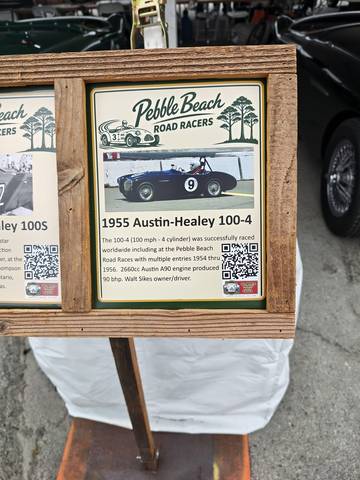
For the gearheads: The course was 1.8 miles in 1950 and 2.1 miles from 1951 on. It mixed paved two-lane road with stretches of dirt and loose gravel. Phil Hill won again in 1953 and became America's first Formula One World Champion in 1961. Carroll Shelby won the last race in 1956 and went on to win Le Mans in 1959. The Pebble Beach Concours d'Elegance started in 1950 as the car show that went with the road races. This year was its 75th, which made Car Week 2026 a fitting time to put the road-race cars back on track. According to the placard, Austin-Healey 100s were entered at Pebble Beach several times from 1954 through 1956.
The Austin-Healey story started with a man named Donald Healey. He built a small, low sports car and called it the Healey Hundred, because it could go 100 miles per hour. In 1952 that was the magic number for a sports car. He took it to the big London Motor Show at Earls Court that October. There, Leonard Lord, the boss of the giant Austin car company, saw it and loved it. He made a deal on the spot to build it in Austin's factory. Almost overnight the Healey Hundred became the Austin-Healey 100. Underneath its swoopy body was an engine borrowed from a sensible Austin family car. It's a bit like putting a school bus's heart into a racehorse, and it worked. The engine had plenty of pull and it was tough. Years later, when Austin-Healey added the tiny Sprite, owners started calling this one the "Big Healey," and the nickname stuck.
For the gearheads: The engine is the Austin A90 Atlantic's 2,660 cc inline four. Its bore is 87.3 mm and its stroke is 111.1 mm. That's a long-stroke, undersquare design built for torque, not revs. It made 90 bhp at 4,500 rpm on twin SU carburettors, which is where the "100-4" name comes from: 100 mph, four cylinders. The first cars, the BN1, used a three-speed gearbox with an electric overdrive working on second and top, so the driver effectively had five forward ratios. The BN2 arrived in 1955 with a true four-speed plus overdrive. Austin built 10,030 BN1s and 4,604 BN2s. Jensen made the bodies, and the cars were finished at Austin's Longbridge plant. In 1953 The Motor magazine tested one at 106 mph flat out and 0–60 in 11.2 seconds. The factory proved the car at Bonneville the same year: a 100 averaged just under 123 mph for 3,000 km and set a string of stock-car records. In 1956 Donald Healey drove a streamlined, supercharged Healey past 203 mph. There were also two faster versions. The 100M had 110 bhp, and 640 were built. The 100S was a lightweight aluminum-bodied racer with 132 bhp, and only 50 were built. It was the first production car with disc brakes on all four wheels. In period racing, 100s ran the Mille Miglia and Le Mans, and in 1954 a 100 won its class and finished third overall at Sebring.
Walt's car is covered in small details that tell you it's a race car. Look at the headlights: each one has an X of black tape across it. If a headlight breaks on the track, the tape holds the glass together so it doesn't scatter across the racing line. The little red arrow marked TOW shows the rescue crew where to hook on if the car needs pulling off the track. The leather strap across the hood is a second latch, so the hood can't pop open at speed. The rows of slots in the hood are louvers. They're little vents that let hot air out of the engine bay. The tall black hoop behind the seat is a roll bar, which protects the driver if the car ever flips. It's a modern safety part you'll find on every vintage racer that runs today. Even Walt's race suit has a clue. The letters "A- NO ALG" on his belt tell the medics his blood type (A-negative) and that he has no allergies, so they don't have to ask.
For the gearheads: The louvered bonnet and leather strap are classic competition touches from the period, the same look as the works cars and the 100S. The full windscreen is gone. In its place is a small aero screen in front of a wood-rimmed wheel, with a seat-back headrest on the hoop and red harness belts. It rolls on knock-off wire wheels. It's the grille that tells you what the car is: the wide, flat oval with the "100" badge set into it belongs only to the 100. When the six-cylinder 100-Six arrived in 1956, the grille changed to a wider oval with horizontal bars.
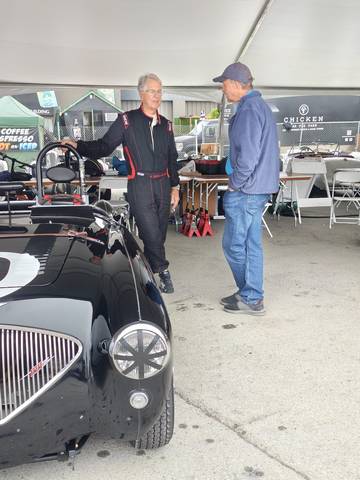
The best part of the paddock is that you can walk up to cars like this. You can look at the tape on the headlights and ask the man in the race suit how it goes through the Corkscrew. Walt clearly didn't mind answering, and he was still smiling when we left.
Sources:
THE SHOP: Record 40-Car Field Set for Pebble Beach Road Racers at Laguna Seca
Pebble Beach: A Wild Ride, the 7-Year History of the Pebble Beach Road Races
Wikipedia: Pebble Beach Road Races
Classic Motorsports: The Big Healey, the 100/3000 Series Classic
CarEvents: Monterey Car Week 2026 and the 75th Pebble Beach Concours
Photos